Post
How to Choose the Perfect Foundation for Your Skincare Tone
Jun
How to Choose the Perfect Foundation for Your Skincare Tone
Finding the perfect foundation is often described as the holy grail of makeup – a quest many embark on, but few conquer without a few missteps along the way. The right foundation doesn’t just cover; it enhances, unifies, and truly transforms your complexion, providing a seamless canvas for the rest of your makeup. Conversely, an ill-matched shade can make you look ghostly, orange, or simply ‘off,’ drawing attention to the makeup itself rather than your natural beauty.
With an overwhelming array of brands, formulas, finishes, and an ever-expanding spectrum of shades, navigating the foundation aisle can feel like deciphering a complex code. Yet, choosing the perfect foundation isn’t about luck; it’s about understanding your unique Skincare characteristics and knowing how to translate that into an ideal product choice. This comprehensive guide is designed to demystify the process, equipping you with the knowledge and practical tips to confidently select a foundation that truly matches your skin tone, undertone, and type, ultimately revealing your most radiant self.
From deciphering the nuances between Skincare tone and undertone to understanding the impact of your Skincare type on formulation, we’ll cover every critical aspect. We’ll also delve into the various finishes available, provide a robust buying guide for in-store and online shopping, share invaluable application tips, and address frequently asked questions to ensure your foundation journey culminates in absolute success. Get ready to bid farewell to mismatched makeup and embrace a flawless, natural-looking complexion every single day.
Understanding Your Skin Tone vs. Undertone
One of the most common pitfalls in foundation matching stems from confusing Skincare tone with undertone. While often used interchangeably, these two concepts are distinct and equally crucial for finding your perfect shade. Getting one wrong can lead to a foundation that looks either too pink, too yellow, or just generally off on your skin.
What is Skin Tone?
Your Skincare tone, also known as surface tone, is the visible color of your Skincare. This is what you immediately notice: fair, light, medium, tan, dark, or deep. It can change seasonally due to sun exposure, becoming lighter in winter and darker in summer. Most people can easily identify their general skin tone category, but this alone isn’t enough for a precise foundation match.
Unraveling Your Undertone
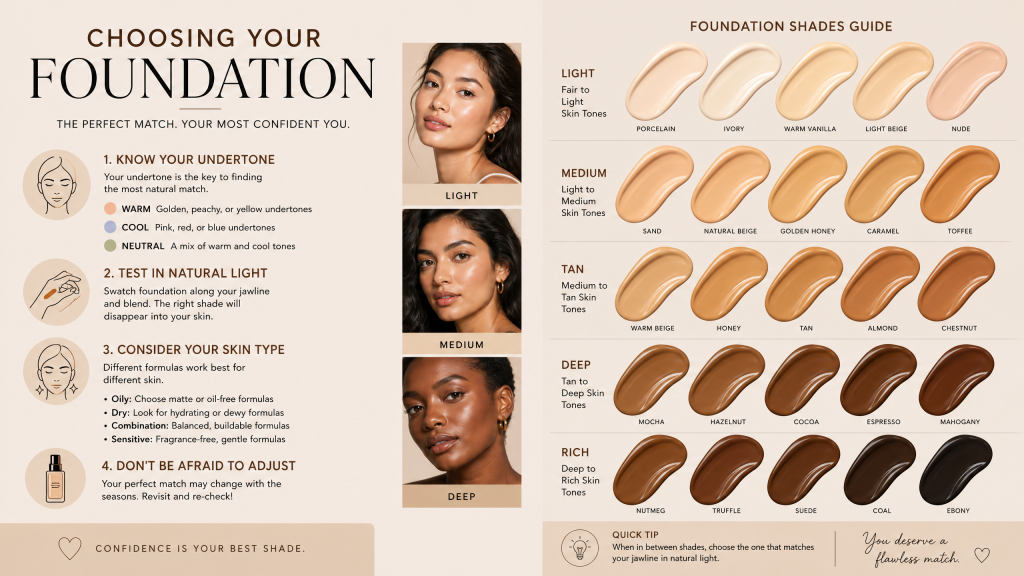
Your undertone, in contrast, is the subtle hue beneath the surface of your Skincare. It remains constant, regardless of whether you get a tan or experience sun damage. It’s the underlying color that affects how your Skincare looks in relation to other colors. There are three primary undertones:
- Warm (Golden, Peachy, Yellow): Skin has a golden, peachy, or yellow tint.
- Cool (Pink, Red, Blue): Skin has a rosy, pink, reddish, or bluish tint.
- Neutral (Mix of Warm and Cool): Skin has a balanced mix of both warm and cool tones, or sometimes appears olive.
Determining your undertone is key to avoiding foundation shades that make you look pasty or orange. Here are a few simple tests you can perform:
- The Vein Test: Look at the veins on the inside of your wrist in natural light.
- If your veins appear green, you likely have warm undertones.
- If your veins appear blue or purple, you likely have cool undertones.
- If you can’t tell if they’re green or blue, or see a mix of both, you likely have neutral undertones.
- The Jewelry Test: Consider whether gold or silver jewelry looks better against your skin.
- If gold jewelry complements your Skincare more, you likely have warm undertones.
- If silver jewelry enhances your skin more, you likely have cool undertones.
- If both gold and silver look equally good, you likely have neutral undertones.
- The Sun Test: How does your skin react to sun exposure?
- If you tend to tan easily and rarely burn, you likely have warm undertones.
- If you tend to burn easily and struggle to tan, you likely have cool undertones.
- If you sometimes burn but eventually tan, you might have neutral undertones.
- The White Paper Test: Hold a piece of pure white paper up to your bare face in natural light. Does your skin appear more yellow/golden (warm), pink/blue/rosy (cool), or olive/grey/balanced (neutral) in comparison to the stark white?
Identifying Your Skin Type
Once you’ve nailed down your skin tone and undertone, the next crucial step is understanding your skin type. Your skin type dictates which foundation formulas and finishes will look and feel best on your skin, ensuring comfort, longevity, and a truly natural appearance.
Why Skin Type Matters for Foundation
Different skin types have distinct needs. A foundation formulated for oily skin, for example, might cling to dry patches on dry skin, while a hydrating formula might slide off oily skin by midday. Choosing a foundation that complements your skin type is essential for achieving a smooth, even, and lasting finish. Here’s a breakdown of common skin types and the foundation characteristics best suited for each:
- Oily Skin:
- Characteristics: Prone to shine, enlarged pores, acne breakouts, makeup tends to slide off easily.
- Best Foundation Types: Matte, oil-free, long-wear, powder, or oil-absorbing liquid formulas. Look for keywords like “mattifying,” “oil-control,” or “shine-free.”
- Finishes: Matte or semi-matte.
- Dry Skin:
- Characteristics: Feels tight, can be flaky, dull, rough patches, fine lines may be more prominent.
- Best Foundation Types: Hydrating, dewy, luminous, cream, or liquid formulas with moisturizing ingredients (e.g., hyaluronic acid, glycerin). Avoid overly matte or powder foundations.
- Finishes: Dewy, luminous, satin.
- Combination Skin:
- Characteristics: Oily in the T-zone (forehead, nose, chin) but normal to dry on the cheeks.
- Best Foundation Types: Balancing formulas, often natural or satin finish liquids. You might need to use a mattifying primer on oily areas and a hydrating primer on dry areas.
- Finishes: Natural, satin, or semi-matte.
- Normal Skin:
- Characteristics: Well-balanced, neither too oily nor too dry, few imperfections, rarely sensitive.
- Best Foundation Types: Most formulas work well! You have the luxury of choosing based on your desired coverage and finish.
- Finishes: Natural, satin, dewy, or matte – depends on preference.
- Sensitive Skin:
- Characteristics: Prone to redness, irritation, itching, or allergic reactions to certain ingredients.
- Best Foundation Types: Mineral-based, fragrance-free, hypoallergenic, non-comedogenic formulas. Look for foundations with minimal ingredients and soothing properties.
- Finishes: Natural or satin, focusing on gentle ingredients.
Exploring Foundation Finishes and Formulations
Beyond matching your Skincare tone, undertone, and type, the desired finish and specific formulation of your foundation play a significant role in achieving your ideal look. The finish dictates how your Skincare will look once the foundation is applied, while the formulation refers to the product’s texture and consistency.
Common Foundation Finishes
The finish can dramatically alter the overall appearance of your skin and should be chosen based on your skin type, preference, and the occasion.
- Matte Finish: Provides a shine-free, velvety look. Excellent for controlling oil and minimizing the appearance of pores. Ideal for oily skin types or for those who prefer a long-wearing, full-coverage look that stays put without shine.
- Dewy/Luminous Finish: Creates a radiant, healthy glow, mimicking naturally hydrated skin. It reflects light, making skin appear fresh and youthful. Best for dry, normal, or mature skin, and anyone desiring a glowing, less “made-up” appearance.
- Natural Finish: Strikes a balance between matte and dewy. It looks like healthy skin – neither overly shiny nor completely flat. A versatile choice that works well for most skin types, especially normal and combination, providing a balanced, everyday look.
- Satin Finish: Similar to natural, but with a slightly softer, more subtle sheen. It’s often described as a soft matte or semi-matte, offering a refined, polished look without being too flat or too radiant. Suitable for most Skincare types.
Popular Foundation Formulations
Foundation formulations vary widely, offering different levels of coverage, textures, and application methods.
- Liquid Foundation: The most popular and versatile type. Available in various finishes (matte, dewy, natural) and coverage levels (sheer to full). Applied with fingers, sponge, or brush. Suitable for almost all skin types, depending on the specific formula.
- Cream Foundation: Thicker and often offers medium to full coverage. Excellent for dry, mature, or normal skin types that need more hydration or coverage. Can be applied with a brush or sponge. Often comes in a pot or compact.
- Stick Foundation: Offers portable, buildable coverage from sheer to full. Great for on-the-go touch-ups. Can be applied directly to the face and blended. Its creamy texture makes it suitable for normal to dry skin, though some oil-free versions work for combination skin.
- Powder Foundation: Comes in pressed or loose form. Provides light to medium coverage and is excellent for absorbing excess oil. Best for oily or combination skin. Can be applied with a brush or sponge. Offers a quick, easy application and a matte finish.
- Mineral Foundation: Typically a loose powder formulation made from crushed minerals. Known for being gentle, non-comedogenic, and often suitable for sensitive or acne-prone skin. Offers light to medium, buildable coverage with a natural or luminous finish.
- Tinted Moisturizer / BB Cream / CC Cream: These offer lighter coverage than traditional foundations, often with added skincare benefits like hydration, SPF, or color correction. Ideal for those who prefer a very natural look or don’t need much coverage. Great for normal to dry Skincare types.
The Benefits of Wearing the Right Foundation
Beyond simply providing coverage, choosing and wearing the perfect foundation offers a multitude of advantages that can significantly enhance your appearance and confidence. It’s not just about masking imperfections; it’s about creating a harmonious base that allows your natural beauty to shine through.
- Enhanced and Even Complexion: The primary benefit is its ability to instantly even out skin tone, reducing the appearance of redness, discoloration, and hyperpigmentation. It creates a smooth, uniform canvas, making your skin look healthier and more polished.
- Conceals Imperfections: A good foundation can effectively minimize the visibility of blemishes, acne scars, dark spots, and under-eye circles, reducing the need for heavy-handed concealing in other areas.
- Boosts Confidence: When your skin looks its best, you naturally feel more confident and put-together. The right foundation can give you that subtle boost, making you feel ready to face the day.
- Provides a Flawless Base for Other Makeup: A smooth, even foundation base ensures that other makeup products like blush, bronzer, and highlight apply more smoothly, blend seamlessly, and appear more vibrant and true to color.
- Offers Skin Protection: Many modern foundations now include SPF, offering an extra layer of protection against harmful UV rays. Some also contain antioxidants or other skincare ingredients that can protect the skin from environmental stressors and pollution.
- Controls Shine or Adds Radiance: Depending on the finish you choose, foundation can help manage excess oil and shine throughout the day, or conversely, add a beautiful, healthy radiance to dull or dry skin, addressing specific skin concerns effectively.
- Minimizes Appearance of Pores and Fine Lines: Certain formulas are designed to subtly blur the appearance of enlarged pores and soften the look of fine lines and wrinkles, contributing to a smoother, more refined complexion.
- Extends Makeup Wear: A well-applied foundation, especially when paired with a primer and setting powder/spray, helps to lock in your entire makeup look, ensuring it lasts longer and stays fresh throughout the day without fading or creasing.
Your Ultimate Foundation Buying Guide
Now that you’re armed with knowledge about your skin tone, undertone, type, and desired finish, it’s time to put that wisdom into practice. The actual buying process requires a strategic approach, whether you’re shopping online or in a physical store. Follow these steps to maximize your chances of finding “the one.”
Before You Shop
- Do Your Homework: Before stepping into a store or browsing online, research brands and specific foundation lines that cater to your skin type and preferred finish. Read reviews from people with similar skin characteristics.
- Check Online Swatches (with caution): Many brands provide online shade finders or virtual try-on tools. While these are helpful starting points, remember that screen color can vary wildly. Look for beauty bloggers or influencers with similar skin tones and watch their swatch videos.
- Know Your Current Perfect Match (if you have one): If you’ve found a great match in the past, note its shade name and undertone description. This information can be a valuable reference point when exploring new brands.
- Go Makeup-Free: Arrive at the store with a clean, moisturized, and primer-free face if possible. This ensures you’re testing on your true skin tone.
In the Store
- Swatch on Your Jawline or Neck: Never swatch foundation on your hand or arm. These areas rarely match your face and neck. The best spot is along your jawline, extending slightly down your neck. You want a shade that disappears into your skin.
- Select Multiple Shades: Pick out 2-3 shades that look closest to your skin tone and undertone. Swipe them in small lines next to each other, leaving a little space in between.
- Step into Natural Light: This is arguably the most critical step. Store lighting (fluorescent lights especially) can be incredibly misleading. Step outside, or at least near a window, to see how the shades truly look on your skin. The perfect match will virtually disappear.
- Wait for Oxidation: Some foundations can oxidize, meaning they react with the air and your skin’s oils, changing color (often becoming slightly darker or more orange) over time. If possible, leave the swatches on for 10-15 minutes and check again in natural light to see if they’ve changed.
- Ask for Samples: If you’re still unsure between a couple of shades, don’t be afraid to ask for samples. Testing a foundation fully at home, under your normal lighting and throughout a typical day, is the ultimate test.
- Don’t Be Afraid to Mix: If you find two shades that are close – one slightly too light and one slightly too dark – you might have found your perfect custom blend. Many people mix shades, especially as their skin tone fluctuates with seasons.
- Consider Your Application Method: Different foundations apply best with different tools. If you typically use a beauty blender, ask if you can test a small amount with one.
Practical Tips for Flawless Foundation Application
Once you’ve chosen your perfect foundation, the way you apply it is just as crucial for achieving a flawless, natural-looking finish. Even the best foundation can look subpar with incorrect application. Here are some practical tips to ensure your foundation always looks its best:
- Prep Your Skin Meticulously:
- Cleanse: Start with a clean face to remove any dirt or oil.
- Moisturize: Apply a suitable moisturizer for your skin type. Allow it to fully absorb (5-10 minutes) before proceeding. Well-hydrated skin provides a smooth canvas and prevents foundation from looking patchy or clinging to dry spots.
- Prime: Use a primer tailored to your skin concerns (e.g., mattifying for oily skin, hydrating for dry skin, color-correcting for redness, pore-filling for texture). Primer creates a barrier between your skin and makeup, helping foundation go on smoother and last longer.
- Choose the Right Tool: The application tool can significantly impact the finish.
- Fingers: Good for light, sheer coverage, as the warmth of your fingers helps melt the product into the skin.
- Makeup Sponge (e.g., Beauty Blender): Ideal for a natural, dewy, streak-free finish. Dampen the sponge before use and bounce/dab (don’t drag) the foundation onto your skin.
- Foundation Brush: Offers more precise application and can build coverage effectively. Flat-top kabuki brushes or dense buffing brushes are popular for an airbrushed look. Use gentle buffing or sweeping motions.
- Start Small and Build Coverage: Dispense a small amount of foundation first. Apply it where you need the most coverage (often the center of your face – around the nose, mouth, and under eyes) and blend outwards. Build up coverage in thin layers only where necessary to avoid a cakey appearance.
- Blend Seamlessly: The key to a natural look is blending. Ensure there are no harsh lines, especially at your jawline, hairline, and around the ears. Your foundation should seamlessly transition into your neck and décolletage.
- Use Color Corrector and Concealer Strategically: Apply color corrector (if needed for extreme discoloration like dark circles or intense redness) *before* foundation. Apply concealer *after* foundation for targeted coverage of blemishes or stubborn dark circles. This prevents you from over-applying foundation.
- Set Your Foundation: To extend wear and control shine, lightly set your foundation with a translucent setting powder, especially in your T-zone or under-eye area. For a fresh, long-lasting finish, a setting spray can melt everything together and lock it in.
- Adjust for Different Areas: You might not need the same amount of coverage everywhere. Use less foundation on areas that don’t need it, allowing your natural Skincare to show through. This contributes to a more natural, less heavy look.
Frequently Asked Questions (FAQ) About Foundation
Even with all the tips and guides, a few common questions frequently arise during the foundation selection and application process. Here are answers to some of the most asked queries:
How many shades should I swatch when testing in a store?
It’s best to swatch 2-3 shades that look closest to your Skincare tone. Pick one that looks like a good match, one slightly lighter, and one slightly darker. This allows you to compare and identify the one that truly disappears into your Skincare.
My foundation looks orange or dark after a few hours. Why?
This phenomenon is called oxidation. It happens when the foundation’s ingredients react with the oxygen in the air or the natural oils on your Skincare, causing the shade to darken or shift to a more orange hue. To avoid this, always test the foundation on your jawline and wait at least 10-15 minutes (or longer if possible) before making a purchase, checking it in natural light. Some foundations are more prone to oxidation than others.
Should my foundation match my face or my neck?
Always aim for your foundation to match your neck and jawline. This ensures a seamless transition between your face and body, preventing that dreaded ‘mask’ effect where your face looks like a different color from your neck. Swatch along your jawline and blend down slightly onto your neck to find the perfect disappearing act.
Can I use different foundations for different seasons?
Absolutely! Many people do. Your Skincare tone naturally changes throughout the year due to varying sun exposure, often getting a bit darker in summer and lighter in winter. You might also prefer a lighter coverage or dewier finish in warmer months and a fuller coverage or more matte finish in cooler months. Having two shades (or mixing them) to accommodate seasonal changes is a very practical approach.
What if I can’t find an exact match for my Skincare tone?
If you’re struggling to find a single perfect shade, consider these options:
- Mix two shades: Purchase two foundations, one slightly lighter and one slightly darker, and mix them together to create your custom shade. This is also great for seasonal adjustments.
- Use a foundation mixer: Some brands offer foundation mixers (typically white, blue, or yellow) that can adjust the tone of your foundation. A white mixer can lighten a too-dark foundation, a blue mixer can neutralize a too-orange foundation, and a yellow mixer can warm up a too-pink foundation.
- Try a different brand: Not all brands have the same shade range or undertone philosophy. Don’t be afraid to explore other options.
Is an expensive foundation always better?
Not necessarily. While high-end foundations often feature sophisticated formulas and luxurious ingredients, many drugstore foundations offer exceptional quality and performance at a fraction of the cost. The “best” foundation is the one that works for your Skincare type, matches your tone and undertone perfectly, and meets your coverage and finish preferences, regardless of its price tag.
Conclusion
Choosing the perfect foundation for your Skincare tone, undertone, and type doesn’t have to be a daunting task. By systematically breaking down the process and understanding the nuances of your own Skincare , you can navigate the vast world of foundation with confidence and precision. Remember, it’s a journey of discovery that begins with truly knowing your Skincare, embracing its unique characteristics, and then finding a product that celebrates and enhances them.
From deciphering the subtle hints of your undertone to selecting the ideal finish and formulation that complements your Skincare type, every step brings you closer to that coveted flawless complexion. Arm yourself with the practical tips for testing and application, and don’t be afraid to experiment, ask for samples, and even mix shades to create your truly custom match. The right foundation isn’t just makeup; it’s an invisible veil that perfects your canvas, boosting your confidence and allowing your natural beauty to shine through without distraction.
So, step forward with renewed understanding and excitement. The perfect foundation is waiting for you, ready to transform your makeup routine and elevate your everyday look. Say goodbye to guesswork and hello to a complexion that truly reflects the radiant you.
